The Meaning Behind Leaving Coins on Gravestones for Memorial Day
Post by: Champion Rarities
in Gold Bullion
The Meaning Behind Leaving Coins on Gravestones for Memorial Day
A Quiet Tradition of Remembrance, Respect, and Service
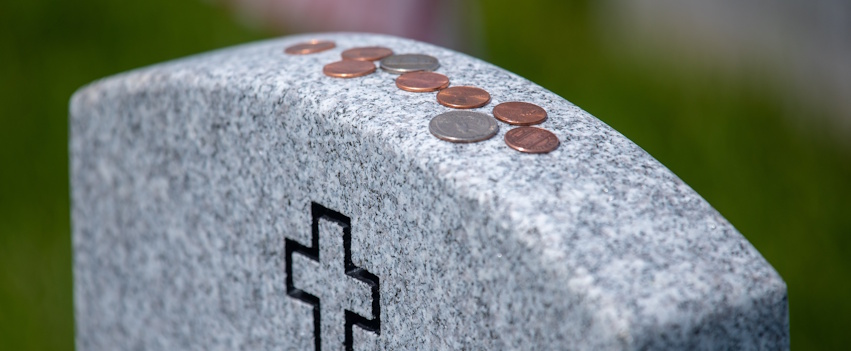
Memorial Day asks the country to slow down and remember. It is a day set aside to honor the men and women who gave their lives in military service, and across the United States, that remembrance takes many forms — flags placed at headstones, flowers set gently at gravesites, and moments of silence shared by families, friends, and strangers alike. At many veterans’ cemeteries, there is another tribute people sometimes notice only after looking more closely: coins resting on gravestones.
To some, a coin may seem like a small object, especially in a world where people often think about coins in terms of collecting, metal content, or even assets like gold bullion. But on Memorial Day, the meaning is different. These coins are not left behind for monetary value. They are left as a message — a simple, powerful sign that someone came, remembered, and paid respect.
What the Coins on Gravestones Mean
Leaving a coin on the headstone of a veteran or service member is a gesture of honor. It tells the family that someone visited their loved one’s grave and took a moment to remember their service and sacrifice. The denomination of the coin adds another layer of meaning, turning a small act into a deeply personal message.
That is part of what makes the tradition so moving. It is quiet. It does not call attention to itself. Yet for the families of the fallen, it can mean a great deal to know that others still stop, still reflect, and still care.
The specific coin left on a gravestone traditionally carries its own message.
A penny means someone visited. It is the simplest sign of remembrance, but no less meaningful for its simplicity.
A nickel means the person who left it attended boot camp with the fallen service member.
A dime means they served together in some capacity.
A quarter carries the heaviest meaning of all. It traditionally signifies that the person who left it was there when the service member died. Wounded Warrior Project lays out these distinctions as part of the long-standing tradition of honoring fallen military members.
A single coin, something most people handle without much thought, can become a deeply personal form of communication. Even in conversations about investment in gold bullion coins or the collector value of a gold bullion coin, coins often represent worth in a financial sense. Here, though, their value is measured in memory, service, and human connection.
Where the Tradition Comes From
Like many customs tied to remembrance, this one has roots that stretch back far. The Department of Military Affairs explains that the practice of leaving coins with the dead can be traced to the Roman Empire, when coins were placed with fallen soldiers for passage across the River Styx. There’s also a related tradition in Navy mythology, in which coins were placed under a ship’s mast to pay the “ferryman” if sailors died at sea.
In the United States, the custom gained wider recognition during the Vietnam War. At that time, it offered a quiet way to honor those who had died during a deeply divisive period in the country’s history. Rather than speaking publicly or drawing attention, a coin could say what words sometimes could not.
Why the Tradition Still Matters on Memorial Day
Memorial Day is not only about ceremony. It is also about individual remembrance. A coin left on a gravestone says that a person stopped for a fallen service member. In a holiday that can sometimes get crowded by noise and distraction, that kind of simple act feels especially meaningful.
It is also a reminder that symbols do not have to be large to be powerful. In everyday life, people may think about coins in terms of collecting, investments, or even physical assets such as gold bullion. But on a veteran’s grave, the coin becomes an acknowledgement – a marker of gratitude.
What Happens To the Coins Afterward
The meaning of the tradition does not end when the visitor leaves. Wounded Warrior Project explains that coins left on military headstones are usually collected and used for cemetery upkeep or to help pay burial costs for homeless veterans. In that way, the gesture continues to serve even after the moment of remembrance has passed.
A Small Gesture With Lasting Meaning
For people who notice coins on gravestones for the first time, the sight can be quietly puzzling at first. Then, once the meaning is understood, it becomes hard to forget. Memorial Day traditions like this one remind us that remembrance is not always loud. Sometimes it takes the form of a single coin, left carefully on a headstone, carrying a message of respect from one American to another.
In a world where coins are often discussed for their rarity, collectibility, or metal content — whether that means gold bullion coins or other forms of value — this tradition points to something deeper. On Memorial Day, the true worth of a coin is not what it could buy. It is what it can say.